Thursday, November 3, 2016

New Vertebrate Discovery! (11/2/16)

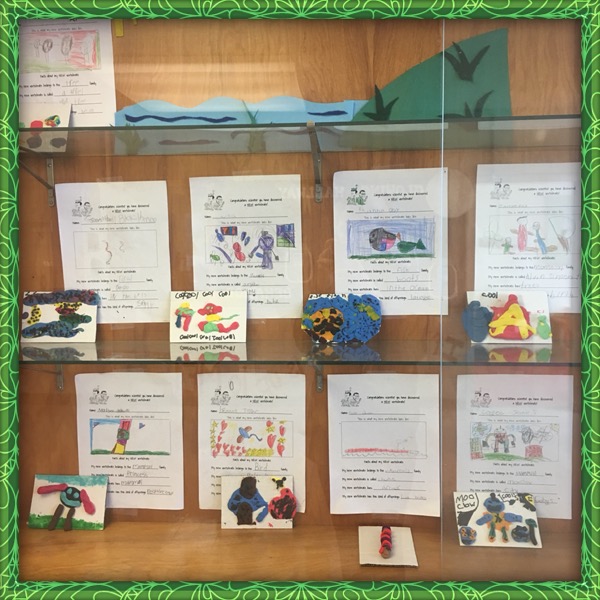
Whoa! Our friends over at Brown Elementary have discovered all sorts of new vertebrate species (in their imaginations, at least). I absolutely LOVE when creativity is combined with science!

Third graders thought up their own new kind of vertebrates, which they molded using clay. First, however, they had to answer four questions:

What family does the vertebrate belong to (ex. mammal, amphibian, reptile)?
What is the vertebrate's name?
Where does the vertebrate live?
What kind of offspring does the vertebrate produce (ex. live, eggs)?

You and/or your kids can try this activity, too! You just need a piece of paper and some clay. Below are some helpful links to help get you started on learning all the things you might need to do to successfully complete this activity.

Learn about the different classifications within the animal kingdom: https://a-z-animals.com/reference/animal-classification/

Learn about how animals give birth to offspring in different ways: http://www.sheppardsoftware.com/content/animals/kidscorner/classification/kc_classification_babies.htm

-A. Judge

Thursday, October 20, 2016

Maker Space at Brown (10/19/16)

Here at Brown Elementary, we are happy to be kicking of the fall season with some new door decorations! Mrs. Sarenac and I have always aimed to create a space where kids can imagine and create, but now we are more explicitly calling our classroom a maker space. I can't wait to see what all the stellar students will make in this space over the next year!

-A. Judge

Friday, September 2, 2016

Kindergarten at Brown: Growth Mindset!

This semester, I'll be working with kindergarten classes at Brown Elementary every week in the STEM lab! To kick off the year, we talked about things we've done before that were hard at first and how we overcame them. Then we watched a really cool video about the "growth mindset," which is really important for learning in any subject! Remember to work hard and learn smart, students!


Thursday, May 19, 2016

Balloon Propelled LEGO Cars at Brown Elementary

The students' task last week was to build LEGO cars and power them using balloons. We watched a few videos to get ideas about how other people engineered their cars, and then the fourth graders were off to the races!

This activity teaches kids' about Newton's third law of motion: "For every action there is an equal and opposite re-action." In this scenario, the initial action is air leaving the balloon, and the car's movement is the opposite re-action. If you watch the experiment in action (just follow the link at the end of the article), you'll notice that the direction in which the air escapes the balloon is in the opposite direction of the movement of the car. Keep that in mind in case you want to make your own and to make sure you understand the concept of Newton's third law of motion!

If you'd like to make your own LEGO car, follow the link below for inspiration, and then make sure to tap into your own engineering skills to make your car go faster and farther!

-A. Judge


https://www.youtube.com/watch?v=dK1H0lzgI_0

Thursday, April 7, 2016

LEGO Engineering Challenge

Since I was out sick last week and didn't want to pass it onto our students, you may be asking yourself "What's next in the world of STEM at Brown Elementary?" Well, besides the kids' ongoing projects, we have the LEGO Engineering Challenge coming up! Third and fourth graders will devise their own LEGO creations with a cool function, like the tiny computer screen you see on the right.

Mr. Darko has engineered some creative LEGO functions already, so these kids will have plenty of inspiration. In the STEM lab, we have a scale made from LEGOs, a virtual percussion instrument made from LEGOs, and motors made from LEGOs (are you seeing a pattern here?).

I can't wait to see the creative, useful ways in which these kids can use LEGOs. This is a prime example of how STEM is not just memorizing facts and using the same methods over and over; science, technology, engineering, and math are dynamic processes that allow for tons of creativity! With experiences like these, our kids at Brown will have the opportunity to grow up to be excellent thinkers and problem solvers.

I will be sure to keep you updated on the LEGO Engineering Challenge, and I hope that my colorful poster (and the mass appeal of anything to do with LEGOs) will draw lots of participants!

-A. Judge

Friday, March 25, 2016

Ocean Depths Sonar Activity

I mentioned our second grade sonar activity in my post last week. Just like with real sonar technology used by submarines and many marine animals, kids at Brown Elementary used the depth of a spot on the "ocean floor" to get a sense of what could be there. We didn't have a sonar transducer, but we were able to use a dowel as a ruler to determine how deep objects were by poking through the holes in the lid of the box. This data was collected and analyzed to map out what we thought the inside of the box looked like.

As an example of how we analyzed our data, the reading in square 1A was 9 units away, but the reading in square 2A  was 6 units away. This told them that there must be something in 2A that is taller (or closer) than whatever is in square 1A.

The kids had a hoot, although they were rather anxious to open the box! If you'd like to learn more about sonar technology, visit the National Oceanic and Atmospheric Administration's website through this link: http://oceanservice.noaa.gov/facts/sonar.html

Til next time, friends!

-A. Judge

Wednesday, March 16, 2016

Brown Elementary Explores the Weather

A few weeks ago, students in the after school STEM program at Brown Elementary learned all about weather, and we finally finished a display to showcase their work. Third graders made kites, second graders made weather vanes, and our kindergarteners colored compasses. Some students took their creations home, but a few were kind enough to let us put their masterpieces on display for a little while! 

Now, whoever walks into the school will see what they've created and hopefully learn a little bit about the weather while they're at it. I'm so proud of these kids and the work we're able to accomplish, even when it's been a long day at school and they just want to go home or run around on the playground.

After finishing up the display, I had the chance to work on an activity for our second graders for next week. I created an "ocean floor" by taping objects to the bottom of a box on a grid. The lid has the same coordinate grid taped to the top. Kids will insert a ruler through holes in the box to see how far down the ruler goes, similar to how submarines and whales send out sonar waves to see how far away the ocean floor is.

Not only will they learn about how sonar technology works, but they'll learn valuable skills about how to collect data and analyze it. I'm looking forward to it--even if they'd rather just open the box to see what's inside instead of using our "sonar technology" (kids were already asking to see inside the box as I was poking the holes).

Can't wait for next week at Brown's STEM Lab!

-A. Judge